· Luis Moreno · business · 10 min read
How to respond to a negative Google review (and when you can report it)
How to respond to a negative Google review in four sentences, what never to write and when you can report it according to Google's official help.

Look.
A bad review doesn’t lose you customers.
The reply you give it does.
Think about who reads it.
It’s not the person who wrote it.
It’s the one who doesn’t know you yet.
They’re on Google.
Comparing three listings.
They see a one-star review.
And they look at what you did.
If you replied calmly, they think: “OK. These people face up to things.”
If you didn’t reply, they think: “These people vanish.”
If you replied angrily, they don’t even think. They move on to the next one.
And then there’s the other temptation.
Paying someone to delete it for you.
Careful.
That doesn’t work the way they tell you.
So here’s how to respond, what can be reported and what can’t.
No tricks.
With what Google says in its official help.
Short answer: how do I respond to a negative Google review?
Wait a few hours.
Reply in four sentences: thank them, acknowledge whatever is true, say what you’ll do and offer to talk outside Google.
No excuses, no attacking and no customer details.
And write thinking of the next customer who will read it: your reply has to answer the doubt they’ll have.
And report only if the review breaks Google’s policy.
If it’s only an opinion you don’t like, you reply.
Before writing anything: what you can do with a negative review
Why you can only reply if your listing is verified
First things first.
To reply you must have verified your business on Google.
If not, there’s no button.
Google’s help says so.
And it’s the first failure I see.
Businesses with an unclaimed listing.
With unanswered reviews.
And not knowing it.
If you’re not sure the listing is yours, first check who owns your website, your domain and your Google listing.
What the customer sees when you reply (and why yours is public)
Your reply appears right under the review.
Public.
As a reply from the business, without your personal name.
The customer gets a notification.
And can change their review after reading you.
That means one thing.
You’re not replying only for whoever will read it.
You’re also replying for whoever wrote it.
It’s like a counter.
If someone complains in front of the queue, you don’t turn your back on them.
Step 1. Breathe before replying
Why replying the same day you read it is almost never a good idea
You read the review.
You heat up.
You open your phone.
You write.
And publish.
No.
Do the opposite.
Read it.
Close the app.
Wait a few hours.
Google recommends replying in a useful, positive way, so people see you care about your customers.
With a hot head, it doesn’t come out.
The question to ask yourself: which part is right?
Almost always there’s a part.
The order arrived late.
The treatment was curt.
The wait was too long.
Not the whole review, perhaps.
But a part.
Start there.
If there’s nothing right in it, you’ll notice that too.
And it’s another path.
The one in Step 4.
Step 2. Write the reply (with a structure that doesn’t fail)
The four sentences any reply to a bad review needs
Four sentences.
No more.
- Thank them for telling you.
- Acknowledge the part that’s true.
- Say what you’ll do or what you’ve done.
- Offer a channel to talk outside Google.
No speeches.
No justifying yourself.
No “we always”.
An example to copy and change
A generic example, not a real customer.
Hello, [name]. Thank you for telling us. You’re right that you waited longer than usual and that’s not what we want for you. We’ve reviewed it with the team and changed [what you change]. If you like, write to us at [phone or email] and we’ll talk it over calmly. [Your name]
Notice what’s missing.
There are no excuses.
There’s no attack.
There are no customer details.
Nor anyone else’s full name.
That last one isn’t a detail.
Google’s policy prohibits publishing third parties’ personal information without consent.
The key: you’re not only replying to them, you’re replying to the next customer
Here’s what almost nobody understands.
The person who left the review has already decided.
They’re angry.
And probably won’t come back.
But others follow.
The ones searching for you today.
They read your listing.
Scroll to the reviews.
And stop at the bad one.
And then they read your reply.
That reply is for them.
For the one hesitating between you and the place across the street.
So don’t write only to close the complaint.
Write to answer the doubt the next person will have.
“Is the wait long here?”
“Is it expensive for what they give?”
“Will they treat me well?”
“If something goes wrong, will they fix it?”
If your reply answers that, the bad review works for you.
Like a salesperson who faces up right when the customer is most doubtful.
Seven templates according to the type of complaint
Copy, change what’s in square brackets and read it aloud before publishing.
If it sounds like a robot, rewrite it.
Under each one you have what the next customer understands on reading it.
They’re generic templates, not replies to real customers.
1. They waited too long
Hello, [name]. Thank you for telling us. You’re right: waiting [time] isn’t normal. [Busiest days or hours] are the busiest, which is why we now [book appointments or send a WhatsApp notice] so nobody waits longer than necessary. If you like, write to us at [contact]. [Your name]
What the next one reads: “If I go that day, I’ll book and not wait”.
2. They thought it was expensive
Hello, [name]. Thank you for your feedback. We understand the price surprised you. In [service or product] we include [exactly what’s included], and we now explain it before starting so nobody gets surprises. If you’d like us to go through it in detail, write to us at [contact]. [Your name]
What the next one reads: “I know what’s included and they’ll tell me beforehand”.
3. They complain about someone on the team’s manner
Hello, [name]. We’re very sorry for how you felt. Here we want everyone to leave treated the way we’d like to be treated, and we’ve talked it through with the team. If you’d like to tell us more, write to us at [contact] and I’ll deal with it myself. [Your name]
What the next one reads: “Here the person in charge faces up”.
Careful.
Don’t name the employee.
Neither to defend them nor to blame them.
4. The service wasn’t what they expected
Hello, [name]. Thank you for telling us. We’re sorry that [what failed] wasn’t up to standard. When something goes wrong, we review it and look for how to fix it. Write to us at [contact] and we’ll look into it. [Your name]
What the next one reads: “If something fails, they sort it out”.
5. There’s a misunderstanding and they’re not entirely right
Hello, [name]. Thank you for writing. We’re sorry the experience wasn’t good. To make it clear to anyone reading: [how it really works, in one sentence and a calm tone]. Even so, we’d love to talk it over. Write to us at [contact]. [Your name]
What the next one reads: “Now I know how it works and it won’t happen to me”.
Don’t argue.
Explain once.
And offer to talk.
6. You can’t find them as a customer
Hello. Thank you for your message. We can’t find any [order, appointment or visit] with these details, and we want to understand what happened because we look after every case. If you’ve been with us, write to us at [contact] and we’ll look into it. [Your name]
What the next one reads: “This review is odd and the business replies calmly”.
And afterwards, if it doesn’t turn up, report it.
I explain this in step 4.
7. One star with no text
Hello, [name]. We’re sorry your experience wasn’t good. We read every review and it would help us a lot to know what happened so we can improve. If you like, write to us at [contact]. [Your name]
What the next one reads: “They read and answer everything here”.
Short.
No assumptions.
Without asking them to change it.
Why a template isn’t enough: every review is a different case
Templates are a starting point.
Not a reply.
Every review is different.
So is every business.
And every customer who reads your reply is looking for something different.
A clinic doesn’t reply like a bar.
Nor does a review that’s right reply like an unfair one.
Knowing what doubt lies behind the next customer, and answering it without it showing, is learned.
It’s one of the things we work on in our consulting, with your business’s real reviews.
If you’re interested, the plans are on the pricing page.
Step 3. What NEVER to write in that reply
The four mistakes that turn a bad review into a crisis
- Arguing with the customer in front of everyone.
- Giving details of what they bought or what happened.
- Saying they’re lying.
- Offering them something in exchange for changing the review.
The last one deserves its own line.
Google’s content policy prohibits offering incentives in exchange for reviews.
And also in exchange for removing negative ones.
A discount for deleting it isn’t a gesture.
It’s a violation.
Why a calm reply is better than a deleted review
A bad review well answered.
Tells something no five-star review tells.
How you react when something goes wrong.
And that’s exactly what someone who hasn’t bought from you yet wants to know.
Step 4. When you can report a review
Which reviews Google removes and which it doesn’t
Here is the story that gets repeated most.
“I got an unfair review. I report it and it disappears.”
No.
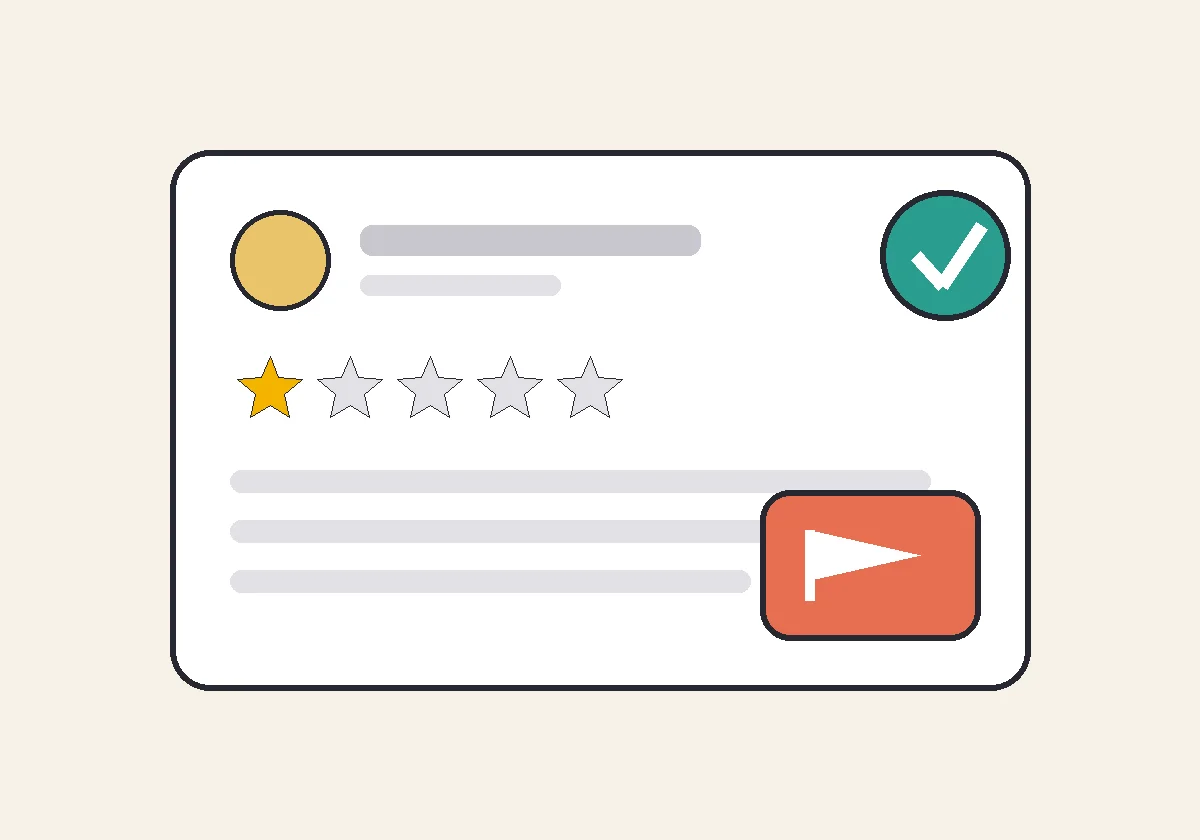
Google removes reviews that break its policy.
Not ones that hurt you.
Not ones that are unfair.
And not ones that seem exaggerated to you.
Describing a bad experience, respectfully, is allowed.
The policy itself says so.
According to Google, what does break it includes things like:
- Reviews from someone who hasn’t been to your business.
- Repetitive content, advertising or promotion.
- Insults, harassment or unfounded accusations.
- Other people’s personal information.
- Fake or paid reviews.
- Conflict of interest.
If your review fits one of those.
Report it.
If it’s just an opinion you don’t like.
Reply.
How to report it and how long it takes
From your Business Profile.
Go to “Read reviews”.
Click “Report review” next to the review.
Choose the reason.
And submit.
Google says the review usually takes several days.
If they don’t remove it and you think they got it wrong, you can appeal once per review.
Once.
So when you report, choose the reason carefully.
Why nobody can promise to delete a review for you
This is important.
You’ll have seen ads.
“We remove negative reviews.”
“Free analysis.”
Look.
Whoever decides whether a review is removed is Google.
And only if it breaks the policy.
Nobody can assure you otherwise.
If someone promises it, be wary.
And ask one thing.
On what specific ground of the policy are they going to report it?
If they can’t answer.
You have your answer.
Step 5. Turn the complaint into something useful
What a negative review tells you that your diary doesn’t
A complaint is data.
Free.
If three people say the same thing, it isn’t bad luck.
It’s a flaw.
Note it down.
Fix it.
And the next time someone mentions it.
You can answer something you couldn’t before.
“We’ve already changed it.”
And if what you’re missing is good reviews to balance it out, here’s how to ask for Google reviews without tricks.
Common questions
Do I have to reply to all reviews?
Ideally yes.
The good ones too.
A short reply with your name is enough.
But if you have to choose where to start.
Start with the negative ones.
They’re the ones read most by anyone who is hesitating.
Can I ask the customer to delete their review?
You can reply and offer to talk.
What you can’t do is pressure them or offer them anything in exchange.
If, after talking to them, they decide to change it, that’s their business.
What if the review is from someone who isn’t even my customer?
Then check whether it breaks Google’s policy.
A review without a real experience of the business can be grounds for a report.
Report it.
And also leave a brief, calm reply just in case.
Quick summary
- Verify your listing so you can reply.
- Wait a few hours. Never reply with a hot head.
- Four sentences: thank, acknowledge, act, offer to talk outside.
- No excuses, attacks, private details or gifts in exchange.
- Report only what breaks the policy. The rest, reply to.
If you’d like me to look at how you’re replying now.
Tell me what business you have.
And which review stings most.
I’ll tell you what I’d reply.
Sources
- Google Business Profile help, replying to reviews: https://support.google.com/business/answer/3474050?hl=en (accessed 02/11/2026).
- Google Business Profile help, reporting reviews: https://support.google.com/business/answer/4596773?hl=en (accessed 02/11/2026).
- Google Maps content policy, prohibited and restricted content: https://support.google.com/business/answer/7400114?hl=en (accessed 02/11/2026).
PS: Let’s go.